Wholesale buyers entering the 2026 bathware market need more than attractive color cards. They need dependable foot comfort, moisture control, and stable performance after repeated washing. A Foot Protection Bath Mat should support safer movement without feeling stiff, bulky, or difficult to maintain. In real bathrooms, small details matter. Wet tiles. Bare feet. Uneven pressure. These moments expose weak product choices quickly.
Podiatrist and human movement specialist Dr. Emily Splichal offers a useful perspective: “A safer bathroom begins with stable contact, sensible cushioning, and surfaces that manage moisture.” This principle guides the product categories explored in this article. Memory foam mats may provide gentle cushioning. Microfiber designs can improve surface drying. Rubber-backed options may strengthen floor contact, though backing quality varies between suppliers. Diatomite-style mats absorb water rapidly, yet some models feel hard underfoot and may require careful handling.
Performance is not everything.
Wholesale buyers should also examine edge finishing, odor retention, drying time, packaging strength, and replacement rates. A beautiful mat that curls after several washes creates customer complaints. A thick mat that blocks a door becomes a return risk. These issues are easy to overlook during sampling.
This guide compares the leading 2026 Foot Protection Bath Mat types for wholesale purchasing. It considers material behavior, user comfort, private-label potential, and practical bathroom safety. The recommendations are useful, but not absolute. Local climate, washing habits, and customer expectations can change the best choice. That uncertainty deserves attention.
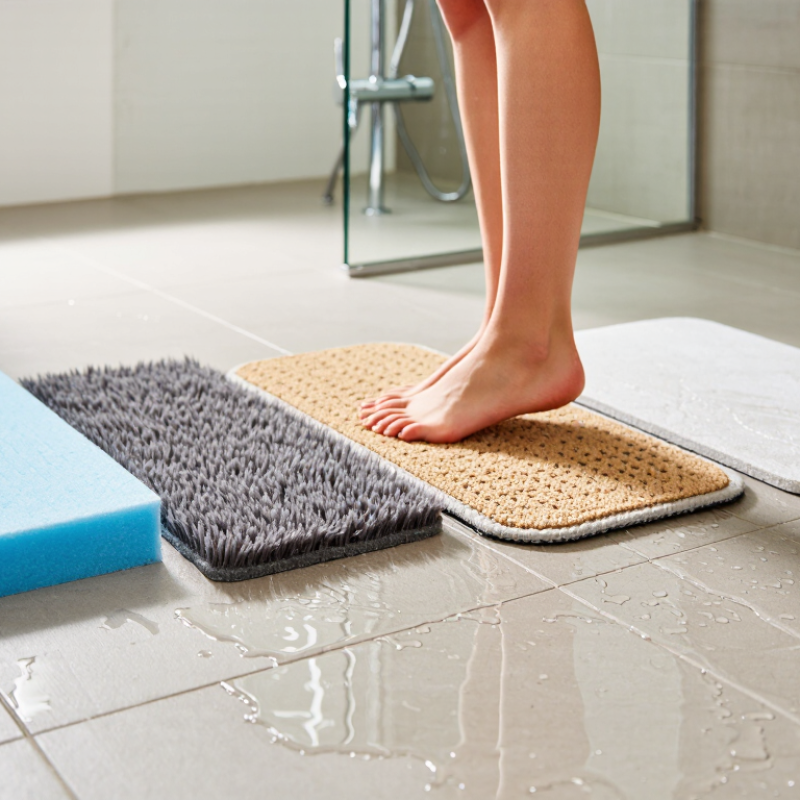
Foot-protection bath mats now serve more than basic floor coverage. Wholesale buyers should evaluate comfort, stability, drying speed, and cleaning demands together. The right type depends on where people stand and how often the mat is used.
Memory-foam mats cushion heels during long bathroom routines. They suit homes, guest rooms, and wellness facilities with dry indoor floors.
Diatomite-style mats absorb surface water quickly and feel firm under bare feet. They work well near showers, but buyers should inspect cracking risks and edge stability.
Microfiber chenille mats provide soft contact and strong water pickup. They are practical for family bathrooms, rental properties, and frequent laundering.
Rubber-backed mats offer useful grip on smooth tiles. However, backing quality matters more than appearance. A weak coating may curl after repeated washing.
Slatted wood or plastic mats allow airflow beneath wet feet. They fit spas and changing areas, though narrow gaps may feel uncomfortable for some users. This detail is easy to overlook.
For wholesale purchasing, request abrasion, slip-resistance, absorbency, and wash-cycle data. Check whether the mat remains flat after drying. Measure packaging size, because bulky cartons raise storage and shipping costs. In shared facilities, choose darker, quick-drying surfaces that reveal fewer marks but still support inspection. A softer mat is not always safer. Test samples with wet feet, different floor finishes, and real cleaning routines before committing to volume.
For 2026 wholesale planning, foot protection bath mats should balance cushioning, drainage, and wet slip safety. Popular options include cushioned PVC mats, quick-drain rubber mats, and textile mats with waterproof backing. Yet softness alone does not protect users. A wet bathroom floor can turn a comfortable mat into a shifting hazard. ANSI A326.3’s ≥0.42 wet DCOF benchmark deserves careful use. This standard mainly evaluates hard surface flooring, so buyers should not treat the number as automatic proof of mat safety.
Tips: Request test reports showing the wet method, surface condition, footwear, and test direction. Ask whether testing covered the complete mat, backing, and intended floor beneath it. Check samples after repeated soaking, detergent cleaning, and edge curling. A dry showroom sample can mislead. Test it near a shower, not only under bright retail lights.
Wholesale teams should also inspect drainage holes, raised textures, and backing stability. Small details matter. A thick mat may reduce foot fatigue but trap water underneath. A textured top may improve grip but feel harsh on bare feet. Packaging should state cleaning limits and suitable floor types clearly. One purchasing mistake is comparing DCOF figures from different methods as if they were identical. They are not. Confirm laboratory competence, batch consistency, and aging performance before approving large quantities. Safety claims should remain specific, measured, and honest.
2026 Top Foot Protection Bath Mat Types for Wholesale Buyers
Material science should guide wholesale bath mat decisions, not appearance alone. PVC mats offer firm structure, low cost, and easy surface cleaning. However, some PVC formulas become stiff in cold storage conditions. TPE feels softer under bare feet and usually bends without cracking. Its higher material cost may be justified for comfort-focused collections. Check the slip rating after repeated wet testing.
Rubber provides strong grip on smooth bathroom floors. It also handles frequent use well, but its odor and weight can affect storage and shipping. Natural rubber may require careful composition checks for sensitive users. Cotton feels warm and familiar, especially in dry residential bathrooms. Yet it absorbs water slowly and can stay damp near poor ventilation. That creates a maintenance concern.
Microfiber dries faster than ordinary cotton because its fine fibers spread moisture across a larger area. It is comfortable, lightweight, and suitable for frequent washing. Still, pile height can flatten after repeated laundering. I have seen attractive samples lose softness quickly. Ask suppliers for abrasion data, colorfastness results, edge strength, and washing-cycle evidence. Inspect the backing after folding and wet-floor testing. Small details matter. A mat that feels secure in a showroom may slide beside a steamy tub. Wholesale buyers should compare packed volume, drying time, odor, and user comfort before setting final specifications.
Indicative material comparison for wholesale selection. Actual performance depends on construction, backing design, thickness, surface texture, washing conditions, and indoor environment.
| Material Type | Typical Construction | Water Absorption | Wet-Floor Grip | Foot Comfort | Drying Speed | Cleaning & Care | Typical Thickness | Temperature Considerations | Indicative Service Life* | Wholesale Positioning |
|---|---|---|---|---|---|---|---|---|---|---|
| PVC | Solid or foamed PVC body with embossed, perforated, or textured top surface. | Very low; the polymer itself is non-absorbent. | ★★★★☆ Good when the surface texture and underside are properly designed. |
Medium; foam-backed versions provide better cushioning than solid PVC. | Fast, provided water can drain from the surface and underside. | Easy to wipe or rinse. Avoid prolonged exposure to strong solvents and excessive heat. | About 3–12 mm | Can become less flexible in cold conditions; excessive heat may cause deformation or plasticizer migration in some formulations. | About 1–3 years in regular household use | Cost-efficient, colorful, easy-care option for value-focused and high-volume programs. |
| TPE | Thermoplastic elastomer sheet or molded structure, often combined with drainage channels or a textured underside. | Very low; TPE is generally non-porous. | ★★★★☆ Good elasticity and surface contact can support stable footing. |
Good; softer and more flexible than many rigid plastic constructions. | Fast to moderate, depending on drainage geometry and surface profile. | Rinseable and easy to wipe. Check compatibility before using chlorine-based or aggressive cleaners. | About 3–10 mm | Usually remains flexible across normal indoor temperatures; formulation determines cold and heat resistance. | About 2–4 years in regular household use | Modern, flexible, and often suitable for premium-feel non-textile bath-mat ranges. |
| Rubber | Natural or synthetic rubber, commonly molded with ribs, suction features, holes, or anti-slip backing. | Low; rubber itself absorbs little water, although porous designs may retain surface moisture. | ★★★★★ Typically strong grip when the floor and underside are clean and dry enough for contact. |
Medium to good; cushioning depends on rubber hardness and profile height. | Moderate; dense rubber dries more slowly than thin plastic because of its weight and textured cavities. | Rinse and air-dry regularly. Avoid prolonged sunlight, ozone exposure, and harsh chemicals that may accelerate aging. | About 3–15 mm | May harden in cold conditions and soften or age faster under prolonged high heat or direct sunlight. | About 2–5 years in regular household use | Strong safety-oriented option for wet areas; heavier freight and odor control should be assessed before bulk purchase. |
| Cotton | Woven, tufted, or looped cotton pile with textile backing; may include a separate anti-slip layer. | High; cotton fibers readily absorb bathwater and foot moisture. | ★★★☆☆ Depends strongly on the backing; wet textile pile alone is not a reliable anti-slip system. |
Very good; soft, warm, and comfortable under bare feet. | Slow to moderate; high absorbency can extend drying time and increase dampness between uses. | Many constructions are machine-washable, but shrinkage, colorfastness, backing damage, and lint should be tested. | About 8–25 mm pile height | Generally suitable for normal indoor temperatures; high heat can cause shrinkage or damage some backings. | About 1–3 years, depending on washing frequency and backing quality | Comfort-led and textile-focused range; requires stronger moisture-management and laundering specifications. |
| Microfiber | Fine-denier polyester or polyamide fibers formed into chenille, shag, suede-like, or flat textile surfaces. | High surface uptake with fast spreading; absorption varies by fiber blend and pile construction. | ★★★☆☆ Usually needs a reliable anti-slip backing for wet-floor safety. |
Very good; dense fine fibers provide a soft, plush foot feel. | Faster than many cotton mats of similar pile height, but thick pile can still hold moisture. | Often machine-washable and quick to clean; avoid high heat if the backing contains thermoplastic or latex components. | About 8–25 mm pile height | Normal indoor temperatures are suitable; excessive dryer heat may warp or weaken the backing. | About 1–3 years, depending on pile recovery, washing, and backing durability | Premium comfort and quick-drying textile positioning; inspect shedding, colorfastness, and backing adhesion. |
*Service-life note: These are practical indicative ranges rather than guaranteed lifetimes. For wholesale approval, request samples and test wet slip resistance, dimensional stability, odor, colorfastness, washing durability, backing adhesion, and packaging compression recovery.
For 2026 wholesale planning, foot protection bath mats should be judged by test evidence, not thickness alone. A soft surface may feel comfortable but lose grip after repeated washing. Buyers should compare microfiber, cotton, rubber-backed, and quick-dry constructions under the same conditions.
ASTM F1677 can support slip-performance evaluation on wet walking surfaces, when the test setup matches the mat’s intended use. Ask for the applied load, wetting method, surface material, and reported critical angle. Small testing differences can change the result. Do not accept a single number without context. Ask for reports, not promises.
ISO 6330 provides controlled washing procedures for checking shrinkage, color change, seam condition, and backing stability. A practical five-wash retention test should measure absorbency, drying time, dimensions, edge curling, and floor contact after each cycle. Photograph the mat before washing and after wash five. The details matter. Test samples from different production batches, because one sample can hide uneven coating or weak stitching. A washable backing may still become less secure. That is worth questioning. Wholesale buyers should record water temperature, detergent type, drying method, and rest time before testing. Clear records make supplier comparisons more reliable and help prevent attractive samples from becoming costly returns.
Wholesale buyers should treat 24-hour drying as a measurable performance target, not a marketing phrase. Test mats after saturation, washing, and room-temperature storage. Record the drying time, water depth, temperature, and airflow. A low-pile microfiber mat may dry faster than thick memory foam, but it can feel less cushioned. That trade-off matters in hotels and rental housing.
The Global Home Textile Market report from Grand View Research estimated the sector at about USD 129.9 billion in 2023. This scale increases buyer pressure for repeatable quality. Ask suppliers for absorbency results, colorfastness data, fiber composition, and test laboratory details. Compliance files should match the destination market. Check chemical restrictions, labeling, packaging materials, and social-audit records. Do not accept a generic certificate. It may not cover the finished mat.
Tips: Set a 24-hour drying pass, then repeat it after five washes. Request an MOQ below your first seasonal forecast. Confirm carton size, gross weight, inner packing, and pallet pattern before ordering. A carton measuring 60 × 40 × 40 centimeters holds 0.096 cubic meters. Small changes can affect freight costs. Leave room for inspection failures. Real factories sometimes miss edge binding or backing adhesion, even with good samples. That uncomfortable detail deserves a written corrective-action plan.
No. The ≥0.42 benchmark mainly evaluates hard flooring. Test the complete mat, backing, and intended floor beneath it. Numbers need context.
Request the wetting method, footwear, applied load, surface material, and test direction. Ask for the reported critical angle. Different methods produce different results.
Test samples before washing and after five wash cycles. Record grip, dimensions, edge curling, seams, and backing stability. Take photographs.
Use 24-hour drying as a measurable pass target. Saturate, wash, and store mats at room temperature. Record water depth, airflow, and drying time.
No. Thick foam may cushion feet but trap water underneath. Low-pile microfiber can dry faster. The trade-off needs practical testing.
Inspect drainage holes, raised textures, edge binding, and backing contact. A textured surface may improve grip but feel rough on bare feet. Small details matter.
Confirm MOQ, carton size, gross weight, inner packing, and pallet arrangement. A 60 × 40 × 40 centimeter carton holds 0.096 cubic meters. Freight estimates can change quickly.
Request documents covering the finished mat, not only raw materials. Check chemical restrictions, labeling, packaging, and social-audit records. A generic certificate may be insufficient.
Test samples from different production batches. Check edge adhesion and coating consistency. We may still miss defects. A written corrective-action plan helps.
The 2026 Foot Protection Bath Mat market emphasizes safer, more comfortable, and faster-drying solutions for bathrooms, spas, hotels, and care facilities. Key types include PVC, TPE, rubber, cotton, and microfiber mats, each offering different levels of cushioning, drainage, grip, absorbency, and cleaning convenience. Buyers should assess wet-slip performance carefully, using the ANSI A326.3 benchmark of at least 0.42 wet DCOF as a reference where applicable rather than treating it as a universal guarantee. Material selection should also consider odor control, skin comfort, resistance to moisture, and long-term shape retention.
For wholesale purchasing, suppliers should provide clear performance data from relevant testing such as ASTM F1677, ISO 6330 laundering procedures, and five-wash retention checks. Practical buying criteria include a drying target of 24 hours or less, suitable minimum order quantities, efficient carton dimensions, consistent color and size, packaging protection, and documented compliance. A balanced evaluation of safety, durability, maintenance, and logistics can help buyers choose products that deliver dependable foot protection while reducing returns and improving customer satisfaction.

Yide Plastic