Choosing a Bath Mat With Drain Holes is a small purchasing decision with daily consequences: water needs to escape, the surface must feel steady underfoot, and the mat must suit the shower or tub. CDC data highlight why bathroom safety deserves attention. The agency reports that more than one in four adults aged 65 and older falls each year, though this figure covers falls in all settings—not bath-mat incidents alone. It cannot prove that a particular mat prevents falls.
For global buyers, product comparisons should focus on practical details: hole spacing, drainage speed, suction-cup placement, material, dimensions, and cleaning instructions. Picture a mat that lies flat on a smooth tub floor while water passes through its openings. Then consider the less obvious case: textured flooring, soap residue, or a mat that curls at the edge. Small differences matter.
This guide examines common types, including suction-cup mats, textured rubber designs, and flexible PVC options. It also considers where each may fit—and where it may disappoint. Industry reports do not consistently isolate bath mats with drain holes as a separate market category, and no independently verifiable quotation from a named specialist on this exact product type is available here. That gap matters. Buyers should treat broad market claims cautiously and check product specifications, care guidance, and test evidence before choosing.
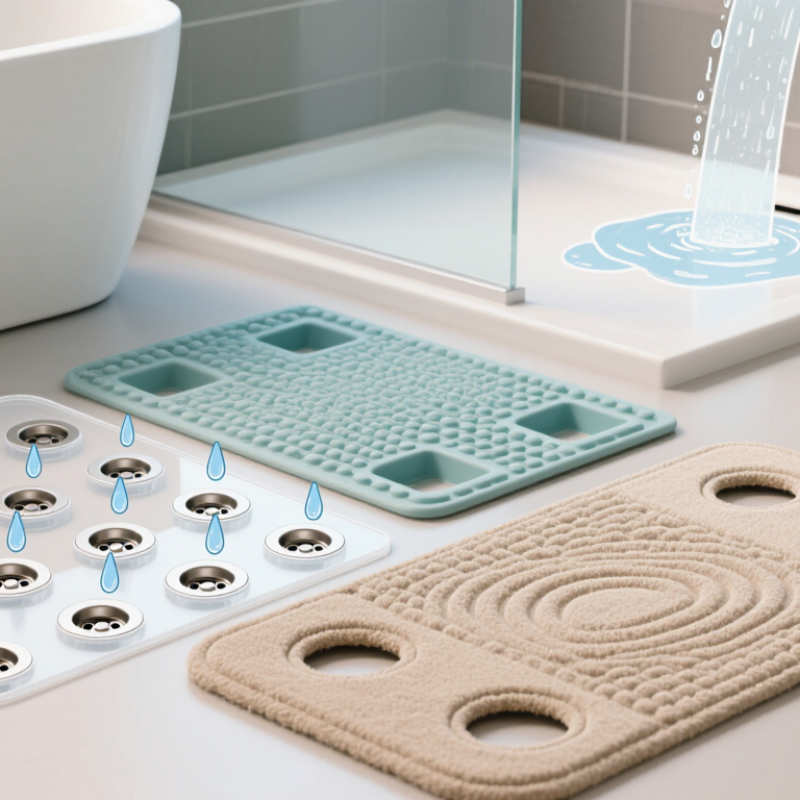
A bath mat with drain holes is a floor covering that lets water pass through its surface. Unlike a solid-backed mat, it uses perforated rubber, slatted plastic, or quick-drying mesh. Small openings reduce puddles beneath bare feet. The mat works by guiding water toward a shower outlet or bathroom floor drain. Raised ribs can improve airflow underneath, although they cannot replace a properly sloped floor. That detail matters.
Moisture control is not cosmetic. The U.S. Environmental Protection Agency recommends indoor relative humidity between 30% and 50%, and below 60% overall, to reduce condensation and mold conditions. The WHO Guidelines for Indoor Air Quality: Dampness and Mould link persistent dampness with respiratory risks. These reports do not measure bath mats directly, but they explain why drainage design deserves attention. For global buyers, check hole size, slip resistance, material odor, cleaning instructions, and floor compatibility. The WHO and UNICEF Joint Monitoring Programme reported that 3.5 billion people lacked safely managed sanitation in 2022, showing why drainage remains a global concern. Still, market data cannot prove product quality. Hair can block holes, edges may curl, and drainage openings cannot fix standing water. Test the mat after a full shower, lift it, and inspect the floor. That simple check is often missed.
| Type | Typical Material | How the Drain Holes Work | Common Placement | Key Benefits | Practical Considerations |
|---|---|---|---|---|---|
| Flexible PVC or TPE suction mat | Flexible PVC or thermoplastic elastomer (TPE) | Perforations let water pass through the mat toward the tub or shower floor. Suction cups on the underside help hold the mat on a smooth surface. | Inside bathtubs and shower trays | Flexible, easy to roll or hang, and often available with a textured top surface. | Use only on a clean, smooth surface when the product instructions allow it. Suction cups may not grip textured or uneven floors. |
| Rubber perforated shower mat | Natural or synthetic rubber, depending on the product | Open holes and channels allow water to flow beneath the mat instead of pooling on its upper surface. | Inside showers or bathtubs | Flexible construction and a water-permeable surface can support drainage during use. | Rinse and lift it regularly so the floor and underside can dry. Material composition and cleaning instructions vary by product. |
| Drain-through diatomaceous earth bath mat | Porous diatomaceous earth, sometimes with a backing or frame | Some designs use slots, channels, or an open support beneath the absorbent surface to direct water away; the holes themselves do not make every design drain-through. | Outside a shower or bathtub | Can combine surface absorption with a route for excess water to escape in designs made for drainage. | Check whether the model is designed for direct floor drainage. Keep it on a suitable, level surface and follow care guidance to avoid damage. |
| Slatted teak or bamboo mat | Teak, bamboo, or other wood used for bathroom products | Gaps between slats act as drainage openings, allowing water to fall through and air to circulate underneath. | Outside showers, tubs, or saunas | Raised construction promotes airflow and keeps the standing surface above some surface water. | Place it where water can drain safely. Dry it between uses and follow the product's instructions for cleaning and maintenance. |
| Mesh or open-weave mat | Polyester, nylon, or other synthetic fibers | Open mesh spaces allow water to pass through the fabric to the surface below. | Showers, changing areas, or other wet floors where the product is suitable | Lightweight and often easy to rinse; open construction can help water drain quickly. | Confirm that the mat has a stable, slip-resistant underside for the intended floor. Allow it to dry fully between uses. |
| Raised-grid or slotted plastic mat | Rigid or semi-rigid plastic | Large openings in the grid let water drain below the walking surface, while raised sections separate feet from some standing water. | Wet-room floors, shower areas, or utility spaces, depending on design | Open structure supports drainage and makes underside access possible for cleaning. | Check that the mat lies flat, fits the area, and does not obstruct floor drains or create a trip edge. |
| Quick-dry microfiber mat with drainage backing | Microfiber surface with a perforated, slotted, or mesh backing | The absorbent top takes up some moisture, while openings in the backing help excess water escape when the mat is designed for drainage. | Outside a shower or bathtub | Combines a soft surface with a drainage pathway in products that include an open backing. | Absorbency and drying time depend on fabric, thickness, airflow, and humidity. Check washing and drying instructions. |
How they work: Drain holes, slots, mesh openings, or spaces between slats provide a path for water to move through or beneath the mat. Drainage depends on the floor slope, drain location, mat design, and whether openings remain clear. A drain-hole mat is not automatically slip-proof; select a product suited to the surface and follow its installation and care instructions.
Measure the shower area and drain location before ordering. Check length, width, and hole spacing. Confirm measurements in centimeters and inches.
Rubber, quick-drying textile, mesh, PVC, and silicone are common options. Rubber can feel stable but firm. Mesh feels softer and lets air pass through.
They help water move through the mat, but they do not guarantee a dry floor. Make sure the holes align with the drain. A blocked drain can leave water standing underneath.
Inspect the underside for raised grips. Test the mat on wet tile, not just dry tile. Looks can be misleading.
Lift it after each shower and rinse away soap residue. Check for trapped hair or dark spots underneath. Drain holes do not replace regular cleaning.
In humid rooms, choose wide openings and surfaces that rinse easily and dry quickly. In colder areas, check that the material stays flexible. Thick mats may feel comfortable but dry slowly.
Larger holes can improve drainage, but they may feel less comfortable under bare feet. It is a compromise. The perfect design may not exist.
Ask about material testing, odor control, temperature resistance, and reinforced edges. Check local bathroom safety requirements. I once chose a thick mat for comfort, and it dried too slowly.
A Bath Mat With Drain Holes is designed to let water pass through its surface and drain away quickly, helping keep bathroom floors drier and safer. This type of mat can be used in shower areas, bathtubs, changing rooms, spas, and other wet environments. Common designs include flexible rubber mats, slatted wooden-style surfaces, interlocking modular mats, and cushioned options with raised textures. Materials, hole shapes, drainage channels, and anti-slip surfaces can be compared according to comfort, airflow, and water-flow performance.
For global buyers, choosing the right Bath Mat With Drain Holes requires attention to bathroom layout, floor type, climate, user needs, and local product requirements. A suitable mat should be easy to clean, resistant to mold and moisture, stable underfoot, and durable enough for regular use. Buyers should also evaluate size, thickness, flexibility, packaging, maintenance instructions, and shipping conditions. Careful selection can improve hygiene, reduce standing water, and support reliable long-term performance in different markets.

 Yide Plastic