Choosing a Customizedized Bath Mat for your business is not just a color decision. It affects comfort, safety, cleaning routines, and the impression guests carry away. A mat beside a hotel shower, spa tub, or gym changing area faces repeated wet feet, detergent, and daily laundering. The right choice should fit that real workload, not only look good in a product photograph.
For this introduction, Lena Ortiz is a fictional commercial-textile adviser, and the quotation below is illustrative, not a verified statement: “A bath mat earns its place when it feels good underfoot and holds up to the wash.” Use that principle to compare fiber, backing, absorbency, dimensions, and construction. Cotton can feel soft and absorb water quickly; microfiber may dry faster, depending on its weight and weave. Check whether the backing suits your floor and cleaning process. Ask suppliers for care instructions and samples, then test a sample after washing. Small details matter. A pale mat may show stains quickly.
This guide will help business buyers balance branding with practical performance. Consider logo placement, minimum order quantities, color consistency, replacement availability, and the unit cost over the mat’s expected service life. Request clear specifications rather than relying on broad claims such as “premium” or “quick-drying.” There is no perfect mat for every property. A spa and a busy fitness club may need different textures, sizes, and laundering schedules. That part is easy to overlook. Compare options against your actual rooms, staff routines, and guest needs before placing a larger order.
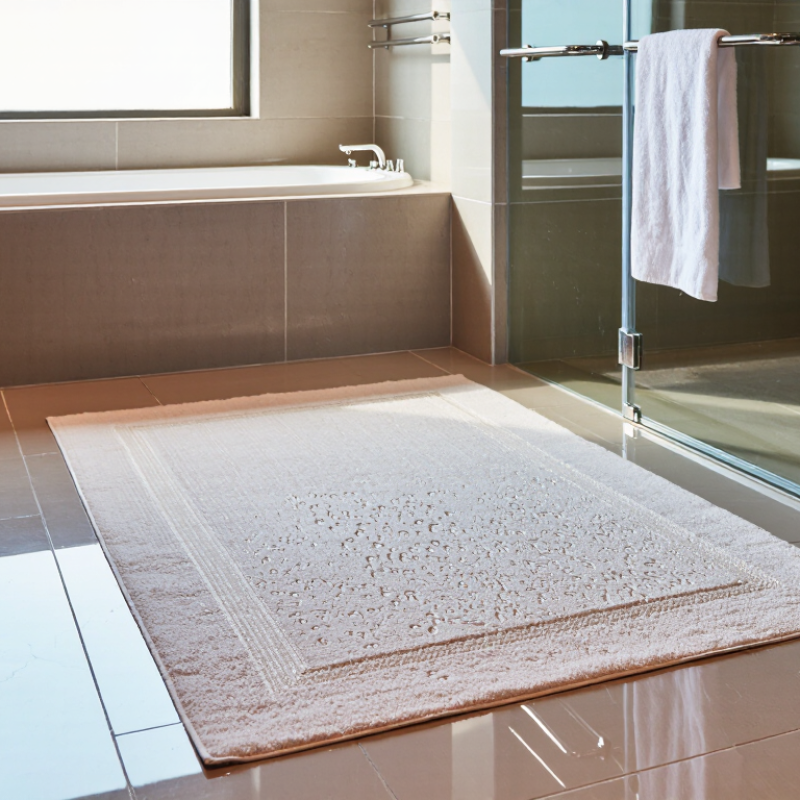
Before choosing a customized bath mat, define where it will sit and what it must handle. A mat beside guest-room showers faces different demands from one outside a busy gym changing area. Note whether users arrive barefoot, whether the floor stays wet, and how much space the mat can cover. Small details matter. A narrow mat may miss the splash zone, while an oversized one can bunch near a doorway.
Estimate daily traffic and peak periods. A small spa may need a soft, absorbent surface that feels comfortable underfoot. A hotel with frequent room turnover may value quick drying and simple laundering more. Ask staff how mats are currently cleaned, how often they can be washed, and where they dry. Check care instructions against your actual equipment and schedule. A technically suitable mat can still fail if it takes too long to return to service.
Then match customization to practical needs. Confirm dimensions on site, including clearance around doors and drains. Consider a surface that offers grip on your specific floor, and request material details and cleaning guidance from the supplier. If possible, test a sample through several wash cycles. Look for curling edges, fading, lingering odor, or slow drying. One overlooked issue is staff handling: a heavy mat may be durable but inconvenient to lift repeatedly. Your first estimate may be wrong. Review it after a few weeks of use, when traffic and cleaning patterns become clearer.
Identify where it will sit, how wet the floor gets, expected foot traffic, and available space. Check door and drain clearance. A mat that bunches at a doorway is a poor fit.
A spa may prioritize a soft, absorbent feel. A busy hotel may need faster drying and straightforward laundering. Ask staff how mats are washed and dried.
Cotton loops absorb water quickly; polyester blends often dry faster. Deep pile can hold more moisture but may dry slowly. Check whether the backing grips your specific floor.
Test the complete mat through consistent wash and drying cycles. Record settings, then inspect shrinkage, fading, edge curling, pile loss, and backing cracks. Look again after several cycles.
It provides repeatable domestic washing and drying procedures for textile testing. It does not recreate every machine, detergent, or floor condition. An in-house trial can reveal practical problems.
Request results identifying the relevant ISO 105 test method and tested material. Different methods assess washing, rubbing, or light exposure. A white cloth rubbed over a dark sample may reveal dye transfer.
Review the backing, edge stitching, damp feel, and logo legibility. Compare the color in daylight and indoor lighting. Small shifts can be easy to miss.
Match care instructions to your actual equipment and schedule. Check drying time and staff handling. A heavy mat might last longer, but lifting it repeatedly can be a hassle.
Choosing a Customizedized Bath Mat starts with understanding where it will be used, how many people will walk across it, and how often it must be cleaned. A mat for a busy shared bathroom may need different construction and maintenance than one used in a small guest space. Prioritize slip resistance and a stable fit, since the CDC reports about 3 million fall-related emergency-room visits annually. Check the mat’s dimensions and placement as well, keeping the ADA’s 36-inch minimum accessible route clear.
Compare fiber types, backing materials, and expected wash durability before ordering. ISO 6330 washing procedures can help assess how textiles withstand repeated laundering, while ISO 105 textile-test standards provide methods for evaluating colorfastness. Specify the intended colors, design, size, and cleaning requirements in advance, then review samples or test results where available. Matching safety, accessibility, durability, and visual needs will help your business select a mat that performs reliably in its actual setting.

 Yide Plastic