China has become a major sourcing base for household textiles, including bathroom accessories and functional floor mats. Grand View Research identifies rising hygiene awareness as a key driver in the global antimicrobial textiles market. Its analysis also highlights demand from homes, hotels, healthcare facilities, and commercial buildings. These trends explain the growing interest in China Top Anti Bacterial Bath Mat Manufacturers.
However, antibacterial performance should never depend on attractive packaging alone. A reliable supplier should provide material specifications, production records, and independent laboratory results. ISO 20743 and AATCC 100 are widely recognized methods for evaluating antibacterial activity in textile materials. Testing under these standards can help buyers compare claims more fairly. The U.S. Environmental Protection Agency also distinguishes between antimicrobial products and products making public-health claims. That difference matters.
A practical review should examine more than surface treatment. Look for absorbency, drying speed, slip resistance, backing stability, wash durability, and odor control. Imagine a damp mat beside a hotel shower, with repeated footsteps and limited ventilation. Weak backing may curl. Poor fibers may retain smell. A strong supplier should discuss these risks openly.
No manufacturer is perfect. Some published test data may use conditions that differ from daily bathroom use. This comparison therefore considers certifications, factory experience, quality control, customization capacity, and export reliability. It also asks a difficult question: does the Anti-Bacterial Bath Mat remain effective after repeated washing? Buyers should verify that answer before placing large orders.
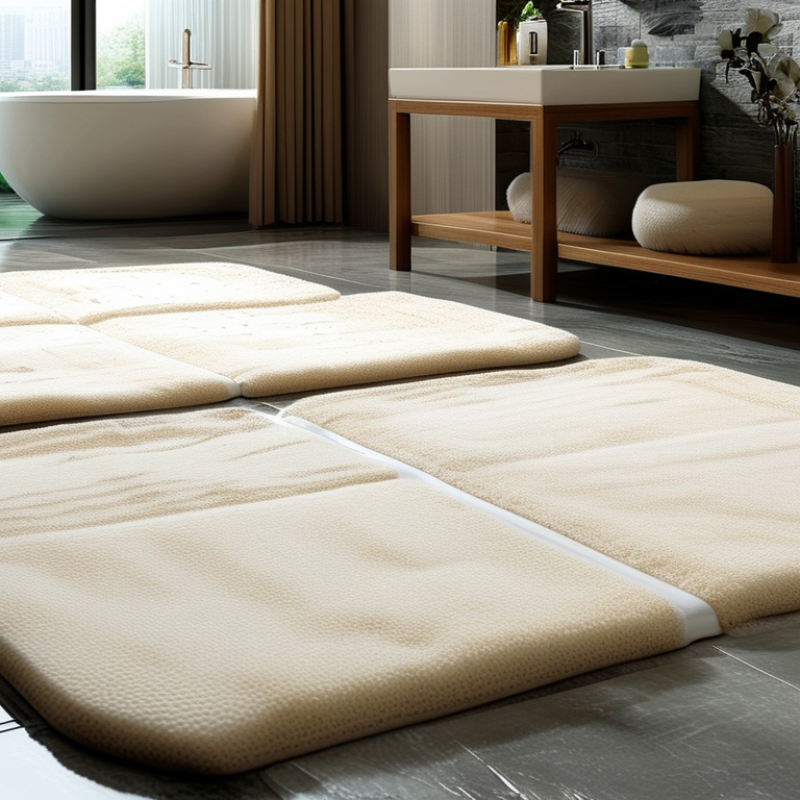
Chinese manufacturers produce several types of antibacterial bath mats for hotels, homes, gyms, and medical facilities. Each material offers a different balance of drying speed, comfort, and maintenance.
Diatomite bath mats use porous mineral material to absorb water from wet feet. Their firm surface feels dry within minutes in a well-ventilated bathroom. However, repeated impact can cause cracking if the board is too thin.
Bamboo charcoal fiber mats provide a softer touch and help reduce unpleasant odors. Their performance depends on fiber treatment, washing temperature, and ventilation. Some factories blend charcoal fibers with cotton or polyester for better shape retention.
Microfiber bath mats remain popular because they feel plush and absorb water quickly. Manufacturers often add antibacterial finishes during fiber processing. These mats need regular washing and complete drying. Otherwise, trapped moisture can create the problem they were designed to control. Softness matters.
PVC and TPE mats usually include drainage holes and textured surfaces. They suit shared bathrooms because water can pass underneath easily. TPE often feels more flexible and less harsh than standard PVC. Memory foam mats offer strong cushioning for users who stand for long periods. Their dense cores may dry slowly, so ventilation holes or quick-dry covers are useful.
Experienced Chinese suppliers commonly provide material samples, color testing, edge inspections, and laboratory reports. Buyers should check the claimed antibacterial test method, not only the product description. Factory quality can vary between batches. That detail is easy to miss. A practical evaluation should include odor, slipping, wash durability, backing adhesion, and drying time after repeated use.
Key Materials and Technologies Used in Antibacterial Bath Mats
When evaluating Chinese bath mat manufacturers, examine materials before surface appearance. Diatomaceous earth absorbs moisture quickly and creates a dry, mineral-like surface. Microfiber mats feel softer and dry faster, but they may retain odors without proper washing. Polypropylene and polyester offer strong color retention, stable shapes, and practical production costs.
Antibacterial performance depends on the treatment, not just the material name. Some mats use silver-based additives, zinc compounds, or antimicrobial polymer blends. These technologies can reduce bacterial growth when tested under recognized laboratory methods. Look for test reports showing the standard, sample condition, and contact time. A vague “antibacterial” claim proves very little. In real bathrooms, poor ventilation and trapped water can still encourage mold. The technology is not magic.
Tips: Check the backing carefully. Thermoplastic rubber or silicone can improve grip on smooth tiles, but textured floors may need a different pattern. Press the mat after washing. If it stays wet for hours, the design needs reconsideration. Ask manufacturers about washing temperature, color stability, odor control, and additive durability. Some treatments weaken after repeated cleaning. That detail is easy to miss. A small drainage gap or raised texture may improve daily hygiene more than an expensive coating. Always compare independent test evidence with actual home-use conditions.
Moisture regain indicates how much water a fiber absorbs under standard textile testing conditions. Lower moisture regain generally supports faster drying, while antibacterial finishes such as silver ions, zinc oxide, quaternary ammonium compounds, and chitosan are commonly used to help control bacterial growth. Antibacterial performance should be verified using standards such as ISO 20743 or JIS L 1902.
A reliable evaluation starts beyond glossy catalogs and low quotations. Ask how long the factory has produced bathroom textiles, which materials it handles, and whether production occurs in-house. Experienced manufacturers should explain polyester, microfiber, PVC, or natural fiber choices clearly. Their answers should match your target market, washing method, and expected floor conditions.
Request product samples from the same production line used for bulk orders. Inspect stitching, edge binding, backing grip, pile density, and drying speed. A bath mat may feel soft but absorb water slowly. That small detail affects daily customer satisfaction.
For antibacterial claims, request current test reports from an independent laboratory. Check the tested material, microorganism standard, test date, and treatment durability. Vague certificates are warning signs. So are promises without measurable data.
Factory reliability also depends on quality control. Ask for inspection procedures, defect records, production photos, and packaging checks. A professional supplier should explain how it controls color variation and backing adhesion.
I once focused too heavily on unit price and overlooked carton compression. Several mats arrived with flattened piles. It was a preventable mistake.
Visit the facility when possible, or arrange a live video inspection. Observe clean storage, labeled materials, and workers checking finished pieces. Communication matters too. Slow replies and unclear revisions can become expensive problems. A smaller manufacturer may offer careful service, but capacity needs verification before seasonal orders.
When comparing China’s top antibacterial bath mat manufacturers, inspect their quality evidence, not only product photos. A reliable supplier should explain the fiber content, backing material, production controls, and testing history. ISO 9001 certification can indicate a documented quality management system, but it does not prove antibacterial performance. Ask for the certificate’s scope and validity.
For antibacterial claims, request independent laboratory reports using recognized methods, such as ISO 20743 or AATCC 100. These tests measure bacterial reduction under defined conditions. Testing should use the finished bath mat, including its pile, dye, and backing. Check the tested organisms, contact time, washing cycles, and reported reduction rate. A textile safety certification, such as OEKO-TEX Standard 100, may help verify harmful-substance limits. It is not a substitute for antibacterial testing. Slip resistance, colorfastness, absorbency, and backing durability also deserve attention. A certificate alone is never enough.
Tips: Request recent reports from an accredited laboratory. Confirm the sample matches mass production. Check whether washing reduces performance. Do not guess. In my experience, suppliers sometimes provide excellent test sheets but vague maintenance instructions. That gap needs honest review. Also examine factory records, batch inspection photos, and complaint procedures. Small details matter. A transparent manufacturer will explain weaknesses instead of promising permanent protection.
China’s top antibacterial bath mat manufacturers support more than simple product purchasing. They help buyers develop, test, package, and export mats for different markets. A serious supplier should provide material details, production photos, sample approval, and recent laboratory reports. Common options include microfiber, PVC, rubber, and quick-drying woven surfaces. Each material affects comfort, drainage, odor control, and shipping weight.
Request a sample before placing a bulk order. Check its grip on wet tiles, edge stitching, drying speed, and color consistency. Confirm the minimum order quantity, production schedule, carton size, and payment terms in writing. Customization may include dimensions, colors, backing patterns, labels, packaging, and printed instructions. Antibacterial claims need credible test evidence and must match the destination market’s requirements. A low quotation can look attractive. It may hide weaker backing or limited inspection support.
Tips: Prepare a simple specification sheet with size, thickness, materials, logo placement, packaging, and target quantity. Ask for pre-shipment inspection photos and carton measurements. Confirm whether export documents include the commercial invoice, packing list, and certificate of origin when needed. Discuss shipping terms clearly, such as FOB or CIF. Leave time for corrections; the first sample is rarely perfect. Even experienced buyers sometimes overlook packaging moisture protection. That mistake can become expensive during a long sea shipment.
| Evaluation Dimension | Common China Manufacturer Offering | Typical Buyer Requirement | Customization Options | Export and Quality Considerations |
|---|---|---|---|---|
| Primary Materials | PVC, TPE, rubber, polyester microfiber, diatomite composite, or other absorbent mineral-based materials. | Select the material according to softness, drainage, absorbency, durability, and target price. | Material blend, surface texture, backing material, thickness, and edge construction. | Material declarations and test samples should be reviewed before bulk production. |
| Antibacterial Treatment | May include antimicrobial additives, treated fibers, antibacterial coatings, or hygienic surface designs. | Request clear information about the active treatment, intended use, and product-care limitations. | Antimicrobial additive selection, treatment concentration, coating type, and marketing claims. | Antibacterial claims should be supported by laboratory test reports relevant to the destination market. |
| Standard Sizes | Common rectangular formats include approximately 40 × 60 cm, 50 × 80 cm, and 60 × 90 cm. | Choose a size that matches bathroom doors, shower areas, retail packaging, and shipping cartons. | Custom length, width, shape, corner radius, and cut-out design. | Confirm finished-product tolerances and carton dimensions before approving the purchase order. |
| Thickness and Weight | Varies by construction; soft textile mats are generally lighter, while mineral or dense rubber mats are heavier. | Balance comfort and stability with freight cost and shelf-packaging requirements. | Foam density, pile height, rubber thickness, layered structure, and product weight. | Weight consistency is important for freight quotations and customs documentation. |
| Slip Resistance | Non-slip PVC, TPE, rubber, or textured backing is commonly available. | Prioritize stable contact with smooth, dry bathroom floors. | Backing pattern, rubberized dots, full backing, embossed texture, and edge grip. | Ask for slip-resistance test methods and usage limitations, especially for wet surfaces. |
| Water Absorption and Drainage | Microfiber and absorbent mineral constructions emphasize rapid absorption; perforated or textured designs support drainage. | Define the required drying speed, absorbency, and resistance to odor during repeated use. | Fiber composition, pile structure, surface pores, drainage channels, and backing ventilation. | Performance should be checked after repeated washing or exposure to moisture. |
| Color and Surface Design | Solid colors, marbling, geometric textures, printed patterns, and neutral home-decoration colors are commonly offered. | Match the product to the intended retail market and interior-design style. | Color matching, custom artwork, printed graphics, embossed patterns, and surface finish. | Approve a physical color sample because screen colors may differ from production results. |
| Private Label and Packaging | Manufacturers may provide woven labels, printed labels, barcode stickers, paper cards, polybags, cartons, or customized retail boxes. | Provide packaging artwork, barcode information, carton marks, and labeling requirements. | Logo placement, packaging material, insert cards, instruction labels, and retail presentation. | Packaging must comply with destination-country labeling and recycling requirements. |
| Minimum Order Quantity | MOQ depends on material, color, size, printing, packaging, and whether the item is an existing design. | Ask for separate MOQs for stock designs, custom colors, custom molds, and private-label packaging. | Lower quantities may be possible for standard products; custom colors and molds generally require higher quantities. | Confirm MOQ in writing together with sampling charges and production terms. |
| Sampling and Approval | Pre-production samples are commonly used to confirm size, color, material, artwork, and packaging. | Approve a signed or documented reference sample before mass production. | Prototype sample, color swatch, artwork proof, packaging mock-up, and pre-shipment sample. | Sample approval should include measurable specifications and permitted tolerances. |
| Production Lead Time | Timing varies by season, order quantity, material availability, customization, and packaging complexity. | Request a production schedule covering sampling, raw-material preparation, manufacturing, inspection, and packing. | Custom molds, special materials, and printed packaging can extend the schedule. | Build in additional time for third-party inspection and international transportation. |
| Quality Control | Typical checks include dimensions, weight, color, stitching or bonding, backing adhesion, surface defects, and packaging. | Use a written inspection checklist with acceptable quality limits. | Inspection points can be adapted to the buyer’s technical specification and retail standards. | Pre-production, during-production, and pre-shipment inspections can reduce consistency and packing risks. |
| Laboratory Testing | Potential tests include antibacterial performance, colorfastness, abrasion, slip resistance, odor, composition, and restricted substances. | Choose tests based on product claims and the regulations of the destination market. | Testing scope, test standard, sample quantity, and laboratory selection. | Test reports should identify the tested product, production material, test method, and report date. |
| Export Documentation | Commercial invoice, packing list, transport document, and customs information are commonly prepared for export orders. | Confirm the required documents before shipment and provide accurate product descriptions. | Additional documents may include certificates of origin, test reports, material declarations, or inspection records. | Document requirements depend on the importing country, buyer, carrier, and product claims. |
| Trade Terms and Shipping | Quotations may be offered under EXW, FOB, CIF, or other agreed Incoterms. | Compare product price, inland transport, ocean or air freight, insurance, duties, and destination charges. | Shipping method, carton configuration, palletization, and delivery port or warehouse. | Incoterms should be stated clearly with the named place or port and the year of the applicable rules. |
| Sustainability Factors | Options may include recycled polyester, reduced packaging, durable construction, and recyclable packaging materials. | Evaluate the complete product life cycle rather than relying only on environmental marketing language. | Recycled content, packaging reduction, fiber composition, and product-care instructions. | Request supporting material declarations or certifications when sustainability claims are used. |
| After-Sales Support | Common support includes replacement discussions, defect review, corrective-action reports, and re-order coordination. | Agree on claim procedures, response times, evidence requirements, and responsibility for verified defects. | Inspection records, defect classifications, replacement policy, and corrective-action format. | Written quality terms provide clearer protection than informal communication alone. |
: Common options include diatomite, bamboo charcoal fiber, microfiber, PVC, TPE, and memory foam mats. Each material balances comfort, drying speed, and maintenance differently.
Diatomite mats can feel dry within minutes in a well-ventilated bathroom. Microfiber also dries quickly. Memory foam usually dries more slowly.
They absorb water effectively and provide a firm surface. Thin boards may crack after repeated impact. Thickness deserves careful checking.
Wash them regularly and dry them completely. Trapped moisture can create odors and encourage unwanted growth. Softness alone is not enough.
Request a laboratory report showing the test method, sample condition, and contact time. A vague antibacterial statement proves very little. Treatments may weaken after repeated washing.
PVC and TPE mats often include drainage holes and textured surfaces. Water can pass underneath more easily. The backing must still grip the floor securely.
Test wet-floor grip, edge stitching, drying time, color consistency, odor, and backing adhesion. Wash the sample repeatedly. The first sample is rarely perfect.
Confirm dimensions, thickness, colors, backing patterns, labels, packaging, and printed instructions. Also check quantity, production timing, carton size, and shipping terms. Packaging moisture protection is easy to overlook.
Approve a written specification and request pre-shipment inspection photos. Compare the final goods with the approved sample. Factory consistency can vary.
No. Ventilation, drainage, washing, and complete drying remain important. A raised texture may help more than an expensive coating. Technology is not magic.
China’s leading Anti-Bacterial Bath Mat manufacturers offer a wide range of products designed for homes, hotels, healthcare facilities, and other high-moisture environments. Common types include quick-drying microfiber mats, diatomite-style mats, PVC or rubber-backed mats, memory foam mats, and washable fabric models. Manufacturers may use antibacterial fibers, antimicrobial surface treatments, non-slip backing, moisture absorption layers, and odor-control technologies to improve hygiene, comfort, and durability.
When evaluating suppliers, buyers should review manufacturing experience, production capacity, material consistency, testing procedures, and customer service. Quality standards and certifications can help verify product safety, antibacterial performance, color fastness, slip resistance, and environmental compliance. Chinese manufacturers commonly support OEM and ODM services, allowing customers to customize sizes, colors, packaging, labels, patterns, and material combinations. They may also provide sampling, inspection coordination, export documentation, and logistics assistance, making it easier for international buyers to develop and order reliable antibacterial bath mat products.

Yide Plastic